
Hard Words to Say: I Love you
Want a little more processing on the bit about the types of Pharisees? I posted about that here.
Communion (or Jesus in a broken cracker)
This sermon focuses on the jewish background to communion. Because several of you have had issues with the church's podcast of this sermon, Click Here for an MP3. (Or right click it and select "save as" or "download..." to save it)
Which Pharisee are You?
- Carries duties upon his shoulders – This is the Pharisee who adds to the law in the Bible thousands of minute details. They place this heavy burden on themselves and everyone who would follow them Knocks his feet together
- Knocks his feet together – This Pharisee had exaggerated humility. He wanted everyone to know how much he was sacrificing, how lowly he was making himself.
- Who makes his blood to flow against walls – This is the Pharisee who so wants to make sure he does not sin by looking on a woman lustfully that he bashes his head against the walls
- Whose head is constantly bowed - This metaphor probably has a close parallel to having your “nose to the grindstone.” This Pharisee was always working never resting always on point.
- Asks, “What is my duty that I may perform it?” – This Pharisee acts as if they have it all together. They have completed every letter of the law and are so perfect that they have to seek out new ways to be faithful.
- From Love (like Abraham) – This Pharisee is obedient out of a love for the blessings God has promised those who are faithful.
- From Fear (like Job) – This Pharisee is obedient out of a healthy fear of the punishment an almighty God has decreed for those who are unfaithful.
- This is the person who insists on getting every “I” dotted and “t” crossed theologically. They place on their shoulders the heavy burden of a complex theological system that demands.
- This is a person whose self-serving false humility shows as they proclaim all their sacrifice of time, money, and status from the rooftops or laptops. I have even (gasp) heard famous pastors talk about how they had given their entire salary back to the church.
- This is the person who allows their focus on keeping themselves from sin to keep them from doing meaningful ministry. They are pure, but never see those in need.
- This may be the person who is a “Christian work-a-holic.” They are always doing ministry or reading their Bible. They do not rest or retreat except when they do so for ministry.
- Similar to #2, this person is the saint who everyone knows is a saint. They not only live a strictly-controlled and apparently sinless life, they make sure everyone knows it one way or the other.
- This is a person who lives a God-oriented life (a life focused on God and becoming who he desires us to be) because they know that God is faithful and blesses those who are faithful.
- This is a person who lives a God-oriented life because they know that God will punish those who do not obey His commands.
Why Grape Juice Instead of Wine for Communion?

This article used to be on the GBOD's site (this was the link), but is no longer available. I was able to locate it and thought it would be interesting to all of you. I am preaching on communion tomorrow and have always found this information somewhat humorous. The original title was, "Changing Wine into Grape Juice: Thomas and Charles Welch and the Transition to Unfermented Fruit of the Vine" by Daniel Benedict.
Most United Methodists are aware that one of our practices is the use of unfermented juice of the grape for Holy Communion. While some other Protestant bodies share this practice, the possibility of the practice goes back to the late 19th century and a Methodist dentist named Thomas Bramwell Welch. (See www.welchs.com/company/company_history.html.) Apparently Welch had scruples about the use of wine and had heard of Louis Pasteur's process of pasteurization of milk. Welch was successful in applying the process to grape juice, and he began to use it in his church, where he was a Communion steward.
His son, Dr. Charles Welch, was an enterprising Methodist layman (a dentist, like his father) from southern New Jersey. He marketed the pasteurized grape juice to temperance-minded evangelical Protestants as authentic biblical "wine." As word spread and as the temperance movement grew among evangelical Protestant churches, Welch left dentistry and produced Welch's Grape Juice commercially.
The impact of the temperance movement and the availability of the "unfermented juice of the grape" can traced in the Book of Discipline and actions of the General Conference of the Methodist Episcopal Church and the Church of the United Brethren.
Methodist Episcopal Church
- The 1864 General Conference on temperance "recommends that in all cases the pure juice of the grape be used in the celebration of the Lord's Supper."
- The 1872 General Conference reaffirms its recommendation of 1864.
- The 1876 permissive rubric based on 1864 recommendation is added at the head of Ritual for Holy Communion.
- In 1880, the General Conference added a semi-mandatory rubric "let none but the pure juice of the grape be used in administering the Lord's Supper, whenever practicable."
- In 1916, the General Conference adopted a mandatory rubric (i.e., "whenever practicable" was deleted).
- The 1964 Book of Worship rubric is emphatic: "The pure, unfermented juice of the grape shall be used." Note that the current ritual texts and rubrics in our Hymnal and Book of Worship do not explicitly define what form of the fruit of the grape shall be used. The United Methodist Book of Worship does recognize that .. .
- the historic and ecumenical practice has been the use of wine
- the use of the unfermented grape juice by The United Methodist Church and its predecessors is an expression of pastoral concern for recovering alcoholics, enables the participation of children and youth, and supports the church's witness of abstinence. (See the 1964 Book of Worship, page 28.)
Church of the United Brethren in Christ
- The 1881 General Conference adds the recommendation to the local church steward's job to provide elements for the Lord's Supper — "and we earnestly recommend the use of unfermented wine."
- The 1885 General Conference adds a semi-mandatory recommendation to the disciplinary job description of local church stewards to provide elements for the sacrament of the Lord's Supper, "always securing, if at all possible, unfermented wine."
- In 1889, the General Conference adopts a mandatory rubric — "always securing unfermented wine."
The MEC, South, apparently never adopted a recommendation or rubric regarding wine in Communion. (Note: The writer of this article has not researched the practice and history of The Methodist Protestant or Evangelical Association/Church on this matter.)
For Additional Information on the Use of Grape Juice in Communion
Betty O'Brien, "The Lord's Supper, Fruit of the Vine or Cup of Devils," Methodist History 31/4 (July 1993) 203-223 and the companion piece, Betty O'Brien "The Lord's Supper: Traditional Cup or Innovative Cups of individuality," Methodist History 32/2 (January 1994) 79-98.
See also William Chazanof''s interesting history of the Welch Corporation — Welch's Grape Juice: From Corporation to Cooperative (Syracuse University Press, 1977).
The General Board of Discipleship is grateful to Dr. Kenneth E. Rowe, Methodist Librarian and Professor of Church History at Drew University, for the historical research and bibliographical information in this article.
The Poetic Echo [Immerse Journal Feature]
That means that you can read it in its entirety by clicking here. Steve Lutz has done a fantastic job with a "going deeper" piece based on the article here. You of course need to go out and subscribe to Immerse here immediately.
The article deals with the way Hebrew poetry is constructed and then ventures to use that to allow a poem by Maya Angelou and scientific findings about electrons to reveal the nature of God.
This is something that I would love for you to help me share by linking to it via twitter or Facebook or clicking the like button. If you are interested in dialoguing with me, please shoot me a line: unpretending@gmail.com
Feature Article Published in Group Magazine
I can't tell you how many times I have heard Louis Giglio's talk, "How Great is Our God," the one with the planets and the cross-shaped molecule, and only once has a person actually given him credit. Besides the obvious moral problem, you will almost never be as effective giving someone else’s talk as you will giving an original.
There’s nothing wrong with using source material and even those prefab talks you get in a lot of youth ministry products, but make them your own. Change the order, illustrations, and wording so that it makes sense to you, and if you didn’t write the majority of it, mention let your audience know that.
{the following is not in the article... WEB EXCLUSIVE :-) } I think the motivation to not quote sources is either that the pastor wants to appear smarter than they really are, or they feel like people wouldn't respect them if they are not using original material. But the truth is, it doesn't matter! Several weeks ago, I used images of Jesus taken out of a book by Alan and Debra Hirsch in my sermon. I mentioned them by name before I went into the images and even referenced them on all the slides. Throughout the week, I got comment after comment of people talking about them as if I had come up with them. No one faulted me for quoting someone else, and many didn't even remember it was someone else's. There is absolutely NOTHING to loose by referencing your source material.
Credit Card Payments Everywhere with Square
 Every time we have been gearing up for some fundraiser or another, I think (at the last minute), "It sure would be convenient if we could take credit card donations/ payments easily. A couple weeks later I have the same thought about registrations for camp. Each time I remember my research into the cost of machine with the receipt paper, the percentage off each sale it takes as well as the per transaction fee and decide it is not worth the hassle.
Then I stumbled upon Square.
Square is simple. From the little one inch by one inch plastic reader that plugs into the headphone jack on your phone (iOS or android) to the flat 2.75% fee per swipe to the super-straightforward, free app there is one word to describe it: simple.
Did I mention cheap? All you have to do to get the reader is give them basic accounting information and they mail it, at no charge, to your home or office a couple days later. How do they make money? Most places charge variable rate fee from 2.5%-5% per transaction and a $0.15 per transaction fee. Some level the percentage to three or three and a half, but square is cheap and simple. 2.75% per card swipe transaction.
The Square app is super easy to use. All you do is download the app, plug in the dongle, log in and you are ready to take a payment. To do that, you enter the amount and an optional description (we put the budget line item and the event) and swipe their card. They are then taken to a signature screen where they can sign with a finger or stylus if you have one. When they press the continue button, they are prompted to enter a cell number or email address where the app immediately sends a link to a receipt for the transaction. The money is then deposited (one lump sum deposit per day) into whichever account you provide.
You then have access to all that data (minus the full card number) in their clean, user friendly site which will allow you to download it in excel format with a ton of data attached to each transaction.
A couple of weeks ago I was stopped on Sunday morning on my way to the youth area by a member who said that he was sorry that he had not yet brought me his donation for a fundraiser. He never has his checkbook at church. I told him that I could take a credit card, and he was relieved. I plugged in the square dongle, opened the app, swiped his card and it was done. Brilliant.
Simple, cheap and brilliant, but not perfect. If you want to use this for multiple ministries, it may get difficult. You will have to sort through all the transactions to figure out which one went to which ministry. It would be nice if they could have sub-accounts to break things out easily.
Overall, I am telling everyone I meet to stop whatever they are doing, go to the Square website and start making life easier for them and their members.
From: YouthMinistryGeek.
Did I Kill Jesus
This is one of the most creative things I have attempted in a sermon... building something while delivering. This is about salvation, but even more about the crucifixion itself and God's purposes behind it.
From: Unpretending
Good Friday, Cucufixion, Palm Sunday Lesson
The lesson revolves around this:
Click Here to Download the PDF.
From:UMYouthPastor
Heaven and Hell Through Google Books
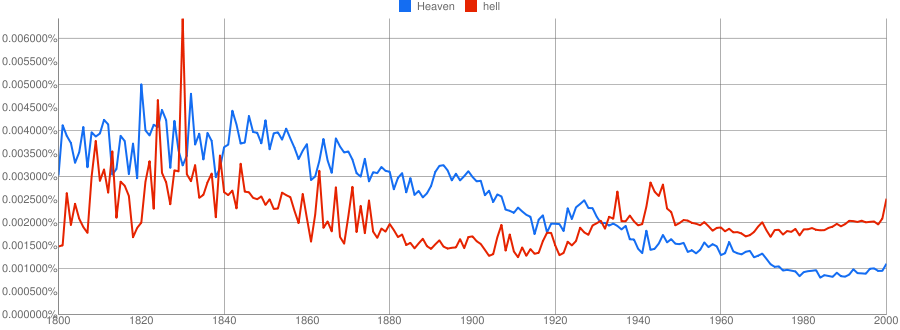
From: YouthMinistryGeek
I look forward to seeing the interesting sets of terms you come up with!
The Path of Discernment
These are important questions, but sometimes they just aren't clear. I was walking and praying about this earlier this week in the woods near our church. For some reason, it is much easier for me to pray while walking outside than sitting still sometimes (imagine that). As I was walking I felt the Holy Spirit speak to me through my surroundings. Sometimes, the path of our life is about to turn, and though we cannot see exactly where it is going, we can see that it is turning ahead. We want to know where it is headed, but cannot because we are simply too far from the turn to be able to see. In these situations, we have to continue waling our path until the turn becomes clear.
From: Unpretending
Eternity and Revelation
From: Unpretending
Why Ashes This Wednesday?

The practice of using ashes as a sign of repentance and/or mourning stretches back millennia. Tamar tore her robes and put ashes on her head after she was raped by her half-brother, Job sits in ashes as his life goes to ruin, and so on. What is interesting is the way that the ashes connect mourning and repentance. This connection allows us to see clearly one interesting aspect of repentance. True repentance has at its root a mourning over the profound disconnection created by sin, and when worn on the forehead as a sign of repentance, as we do on Ash Wednesday, the ash is a sign to others around us that we are taking time to mourn the loss created by sin and reconnect with God.
In Jonah, we see a man coming with no name or reputation and delivering a simple message of the judgment of God unless the people repent. This is what many believe Jesus meant when he spoke of the “sign of Jonah.” Jesus was talking about those times when we hear the voice of God through a stranger; when someone we know little or nothing about speaks words that resonate in our soul as if God himself were speaking.
This is an excerpt from the youth curriculum I wrote for Fearless: The Courage to Question. The material is free, a media bundle with videos and graphics is only $25.
Is the iPad2 a Ministry Expense?
Status and Citizenship
Who knew the Bible was so political? The book of Phillipians gives intense input on status and citizenship.
From: Unpretending
Icebreaker: Popcorn Sharing
Decide who will start the game and give them the bag of popcorn. The person to the popcorn-holder’s right, chooses from one of the following questions that the popcorn-holder will have to answer. Then the popcorn-holder will give their answer in the following steps: Say a single answer, put a piece of popcorn in their mouth, say another, put another piece in their mouth. If anyone in the group can count to ten in between their answers, their turn is over and the bag passes to the right. If the group leader cannot understand the words the person is saying, their turn is over and the bag passes to the right.
- What are the names of several government officials?
- What are the names of several BAD-Quality Pop-musicians?
- What are the names of several GOOD-Quality Pop-musi- cians?
- What are some funny YouTube videos?
- What are some good books?
- What are some of your favorite celebrities?
- What are some actors/actresses?
- What are some GOOD movies?
- What are some BAD movies?
King, Manger, and Palace
From: Unpretending
One Night for Nigeria (Super Bowl with A Purpose)
He only needs $50 per leader to bring them in for two days, feed them, and give them all the supplies and training they need to create one water filter and one fuel efficient cookstove! That should blow your mind... $50 saves a family!
Our youth are making this year's super bowl party about raising money for this essential project. Each student who comes pays $5 (4 of which goes to Raphael). They are all raising money on their own by doing chores, skipping fast food for a couple of weeks, etc.
How Can You Help?
- Agree to partner with our students by giving a dollar or fifty cents per student who comes
- Donate some food or other item to offset our cost for the event
- Send your students and their friends (or bring your friends if you are a teenager) to the party on February 6 at 5pm.
- Help us Promote the event on Facebook, with email forwards... you can link to this article too!.
Shavuot and Acts 2
Pentecost (literally the fiftieth day) is the beginning of the Jewish festival of Shavuot. This is the religious festival that was all about celebrating God giving the law (torah) to the people of Israel (which coincidentally happened fifty days after the Exodus).
If you remember your flannelgraph correctly, you may remember seeing a fire at the top of the mountain. This passage (along with Ezekiel 1-2) is one of the theophanies (visible manifestation of God) that the Jewish people read during the feast of Shavuot. The other main reading for this Festival comes from the book of Ruth. That is interesting because the book of Ruth foreshadows the incorporation of the Gentiles into the people of God as she is not a Jew but a Moabite (who are forbidden in Deuteronomy 23:3 to be part of the Jewish people... they are to be totally separate).
What a beautiful setting for the giving of the Holy Spirit! The festival celebrates the moment when all the people saw a fire on top of the mountain and received the Law that was to help them cover their sin and live in right relation to God once again. Now, through the sacrifice of Jesus Christ, the fire is no longer on the mountain, but separates and rests on them individually. It fills them and they cannot help but cry out! The law that is being celebrated in Shavuot is being fulfilled before their very eyes.
From: Unpretending
Inception Parody (4 Scences)
From: UMYouthpastor.com